
Autumn Budget 2026 | What It Means for Landlords and Property Investors

Chancellor John Healey delivered his first Autumn Budget today, and there was one headline that stood out: the tax on rental income is going up again.
There was no stamp duty shake-up and no rise in capital gains tax, so the picture is not all bad. But landlords who hold property in their own name will pay noticeably more from April 2027, and that changes the numbers on some portfolios.
Below, we have pulled together everything property investors need to know - what has changed, what has not, and what we think it means for landlords in Greater Manchester and beyond.
The Budget at a glance
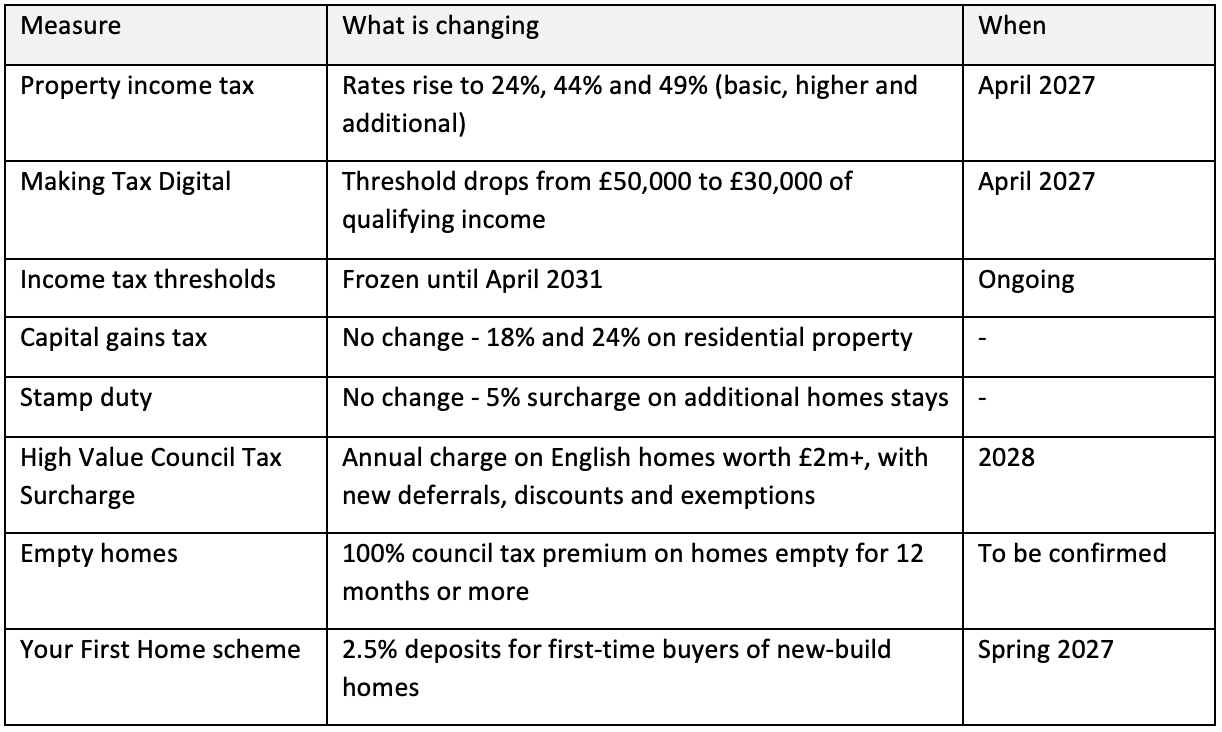
1. Rental income tax rises again
This is the big one. Last year's Budget had already confirmed that tax on property income would rise by two percentage points from April 2027, taking rates to 22%, 42% and 47%. Today the Chancellor added a further two points on top.
From April 2027, individual landlords in England, Wales and Northern Ireland will pay:
• 24% at the basic rate (up from 20% today)
• 44% at the higher rate (up from 40%)
• 49% at the additional rate (up from 45%)
What that looks like in practice: a basic-rate landlord with £10,000 of taxable rental income pays around £2,000 in tax today. From April 2027, that becomes around £2,400. For a higher-rate landlord, the same cost goes from roughly £4,000 to £4,400.
A few other details worth knowing:
1. Mortgage interest relief is given as a tax credit at the property basic rate. The government has confirmed this will rise to 24% too, in line with the new basic rate.
2. Your Personal Allowance will be set against employment, trading and pension income first from April 2027. If you have a salary or a business as well as rental income, more of your rental profit could fall into the higher bands.
3.Limited companies are not affected. Properties held in a company pay corporation tax instead - more on that below.
With income tax thresholds also frozen until 2031, rising rents will gradually pull more landlords into higher tax bands over time.
2. If you own through a limited company, the company itself was left alone
The rise in property income tax only applies to landlords who own in their own name. Properties held in a limited company pay corporation tax on their profits, and corporation tax was not touched. Dividend tax was also left alone this time, after last year's increase.
That does not make incorporating right for everyone. Moving existing properties into a company can trigger stamp duty and capital gains tax, and the government also plans to change how company distributions are taxed from April 2028. It is a decision to make with specialist advice, not in a hurry.
3. The OBR's warning on rents
The Office for Budget Responsibility, the government's own forecaster, was unusually direct. It said the measures "risk leading to a steady rise in rents", and judged a long-run rise more likely than not.
It gave two reasons. Fewer new landlords are likely to enter the market, which squeezes supply. And as some existing landlords sell up, those who remain will have more room to raise rents.
That is unwelcome news for tenants. For landlords, it suggests demand for well-run, well-priced homes will stay strong. But under the Renters' Rights Act, rent can only be increased once a year through the proper process, so getting your pricing right at the start of a tenancy matters more than ever.
4. Making Tax Digital comes in sooner for more landlords
From April 2027, landlords with more than £30,000 of qualifying income will need to keep digital records and send quarterly updates to HMRC. Qualifying income is your gross rent plus any self-employment income, before expenses - so many landlords with just two or three properties will now be caught.
If you still manage your accounts on paper or in a spreadsheet, now is a good time to get organised.
5. Capital gains tax and stamp duty: no change
After months of speculation, capital gains tax on residential property stays at 18% and 24%, with the £3,000 annual allowance unchanged. The only change was a cut to Business Asset Disposal Relief, which rarely applies to rental property.
Stamp duty was also left alone, including the 5% surcharge on additional homes. For investors, that at least brings some stability: the cost of buying and selling is the same tomorrow as it was yesterday.
6. The "mansion tax" and empty homes
The High Value Council Tax Surcharge on homes in England worth £2 million or more is going ahead from 2028, starting at £2,500 a year and rising to £7,500 for homes worth over £5 million. The government has now confirmed a deferral scheme and a range of discounts and exemptions. It is paid by the owner, not the occupier, so a let property above that value would be caught.
Few rental properties in Greater Manchester will be affected. More relevant for most landlords is the new 100% council tax premium on homes left empty for 12 months or more. If you have a property sitting vacant or a refurbishment that has stalled, it is worth getting it moving.
7. Energy bills: tenants, HMOs and the fine print
Around 20 million households in England in council tax bands A to D will get a one-off £100 Household Energy Payment from January 2027, paid straight into their bank accounts. VAT on household electricity is also being removed until July 2027, and gas standing charges are being scrapped for millions of homes from 2027.
For single lets where the tenant pays the council tax and the bills, this is simple - the help goes to them. HMOs and bills-inclusive lets are where it gets fiddly:
1. Who receives it. In many HMOs the landlord pays the council tax, so the payment could land with you rather than your tenants. The government has said more detail is coming for households that do not pay council tax by direct debit.
2. Passing it on. When energy support was paid in 2022, landlords were required to pass it on to tenants on all-inclusive bills. Expect the same principle here: help meant for tenants should reach tenants.
3. Reselling energy. If you charge tenants for energy, you cannot charge more than you pay, so lower prices from the VAT cut should flow through to what you charge.
We will update this once the guidance is published. In the meantime, make a note of which of your properties are bills-inclusive and who pays the council tax on each.
8. Support for first-time buyers
The new Your First Home scheme launches in spring 2027. First-time buyers of new-build homes in England will be able to buy with a 2.5% deposit, backed by a government equity loan of up to 20%. Household income caps are set at £110,000 outside London and £140,000 in London.
There were also changes to savings for first-time buyers:
From 29 October 2026, the penalty for using a Lifetime ISA on a home above the £450,000 cap falls from 25% to 20%.
From April 2029, a new First Time Buyer ISA will replace the Lifetime ISA for new savers.
9. Greater Manchester: what's in it for us
Devolution was one of the biggest themes of this Budget, and Greater Manchester is near the front of the queue. Most of it comes with conditions attached, but the direction is clear.
1. Business rates retention. Greater Manchester is in the first wave of Business Rates Retention Zones, subject to approval and legislation. Councils inside a zone can keep business rates growth for 25 years and invest it locally.
2. Investment funding. £285m of Good Growth Fund seed money across England in 2027-28, plus a £1.5bn borrowing facility for mayoral authorities from April 2028.
3. Bury. £10m towards restoring the indoor market building, subject to a final business case. Bury is one of our core areas, and town-centre investment tends to lift the streets around it.
4. Jobs. A new Centre for Cyber and AI Excellence in Manchester, and Convatec is investing over £500m in a global R&D hub in the city. More well-paid jobs in the city centre means more tenant demand in the surrounding boroughs.
5. Visitor levy. Mayors can now charge a percentage-based levy on short-term, commercially let visitor accommodation, with plans expected by March 2028. If you run serviced accommodation or short lets, assume it is coming and build it into your pricing.
The OBR's wider forecasts point to steady rather than spectacular conditions. House prices are forecast to rise around 2% this year and 2.5% to 2.75% a year after that. Inflation peaks at 3.8% in early 2027 before easing, and the average rate on outstanding mortgages edges up from 4% to around 5% by 2031 as cheaper fixes end.
Nothing there says boom, and nothing says crash. It describes a market where rental income and leveraged growth does the heavy lifting - the kind of market we have been working in across the North West for the last couple of years.
What does this mean for landlords and investors?
There is no getting around it: holding property in your own name has become more expensive. But we do not think this is a reason to panic, and for well-run portfolios the fundamentals have not changed.
Here is how we see it:
1. Net returns matter more than ever. When more of your profit goes to tax, voids, arrears and unexpected repair bills hurt more too. Good management, reliable tenants and well-maintained properties have a bigger impact on what you actually take home.
2. Structure is worth reviewing. Whether you hold property personally, jointly or through a company now makes a bigger difference. Speak to a property-specialist accountant before changing anything.
3. Knee-jerk decisions rarely pay. Selling or restructuring in a rush can trigger costs that are certain, to avoid ones that are not. Take time to look at the numbers property by property.
What we would actually do with this
If you own personally and pay higher-rate tax: get a proper review before April 2027. The gap between 44% personally and 25% in a company on reinvested profit, plus full interest relief, is now wide enough that incorporating can cover its one-off costs over a reasonable hold. Not always, though - particularly if you draw all the rent to live on - so it needs your real numbers, not a rule of thumb.
If you own personally and pay basic-rate tax: 24% is irritating, but not a reason to restructure on its own. Review your rents against the market, keep receipts for everything deductible, and get ready for Making Tax Digital if you are over £30,000.
If you own through a company: there is nothing to do today. Add the April 2028 distributions changes to your next accountant meeting if your exit plan involves anything other than dividends or a sale, and keep your director's loan account tidy.
If you are buying: conditions currently lean towards buyers. There is plenty of stock on the market, sellers are trimming asking prices, rents are rising, and the Budget left the buying side alone. Buy carefully, through the right structure, in the towns where the investment is going.
We will go through the Finance Bill when it is published and update this article if anything changes.
How Donelan Property can help
Whether you want to get more from the properties you already own or you are looking for your next investment in Greater Manchester, our team is here to help. From fully managed lettings to sourcing and hands-off investment, we can help you build a portfolio that works harder for you.
More insights & news






Unlock the full potential of your property investments
Get in touch and let's talk about how we can elevate your property investments. Reap the rewards of a stable income and significant capital growth with our expert insights and tailored strategies.


